
TL;DR: There are three legal routes out of an Estonian OÜ and they are taxed under three different rules. A board member fee (juhatuse liikme tasu) carries 22% income tax plus 33% social tax and is taxable in Estonia no matter where in the world you performed the duties. Salary for ordinary work is taxed the same way plus unemployment insurance, but for a non-resident who does that work entirely outside Estonia it is not Estonian income at all. A dividend costs the company 22/78, which is 22% of the gross payout. If you hold an A1 certificate from another EEA state, Estonian social tax on the board fee disappears and the fee ends up costing the company exactly what a dividend costs. This is information, not tax advice.
The route most e-resident founders default to (take everything as dividends, pay yourself nothing else) is the one the Estonian Tax and Customs Board explicitly writes about, and not approvingly.
What are the three ways to take money out of an Estonian OÜ?
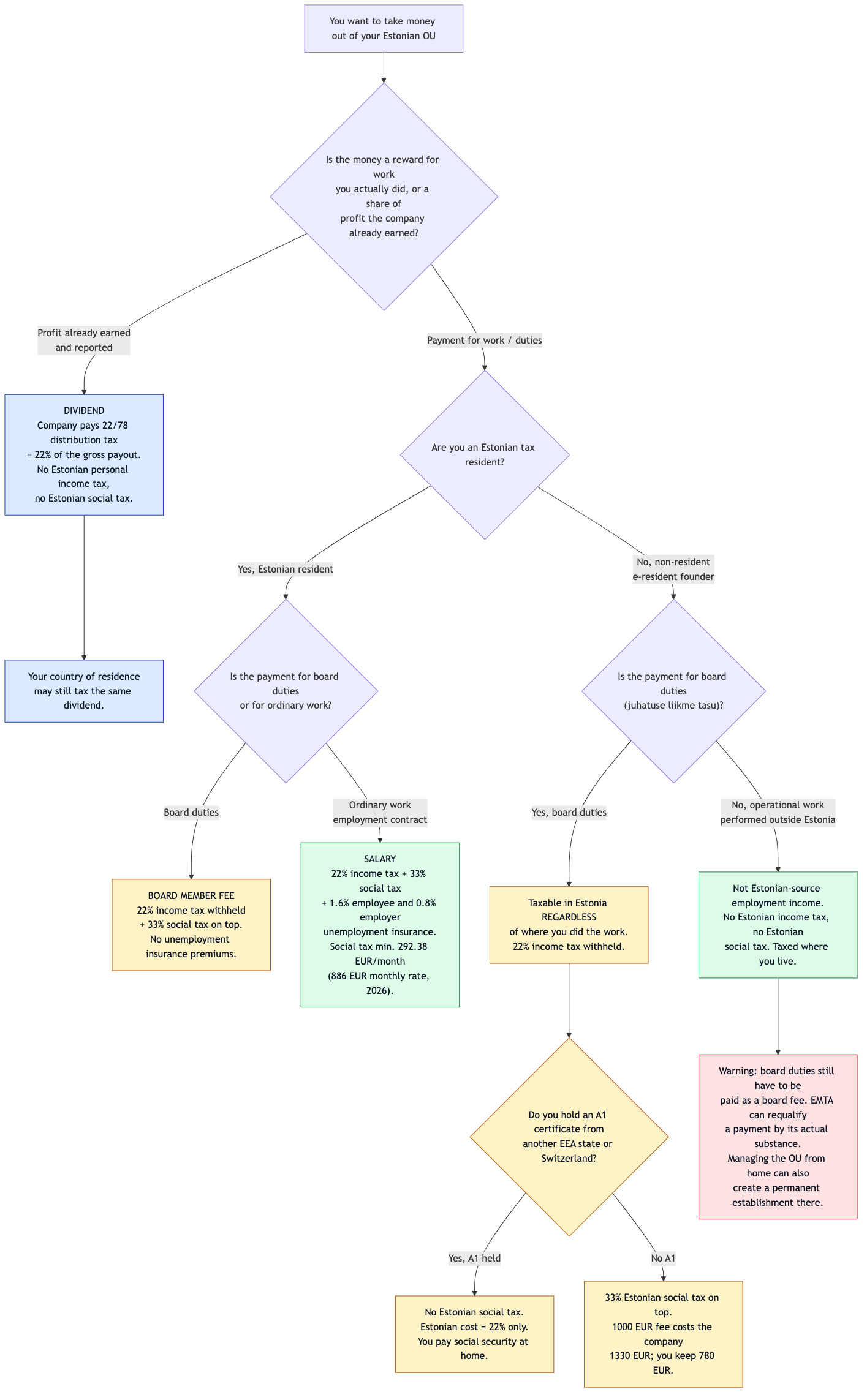
Board member fee, employment salary, and dividend. They are separate legal instruments with separate tax bases: the fee and the salary are labour income taxed when paid, the dividend is a distribution of profit the company has already earned and reported. You cannot relabel one as another to get a better rate. The tax authority taxes payments by their actual substance.
The practical decision is not "which is cheapest" but "which one is the correct label for this particular payment", and only then "what does that label cost".
How is a board member fee (juhatuse liikme tasu) taxed?
A board member fee is subject to 22% income tax, withheld by the company, and 33% social tax paid by the company on top of the gross fee. It carries no unemployment insurance premiums. On a 1000 euro gross fee the person receives 780 euros, the company pays 330 euros of social tax, and the total cost to the company is 1330 euros.
The two rates come straight from the acts. Income tax is 22% under § 4 (1) of the Income Tax Act as in force from 1 January 2025. Social tax is 33% under § 7 (1) of the Social Tax Act, and § 2 (1) 4) of the same act names remuneration paid to a member of a management or controlling body as an object of that tax.
The reason there is no unemployment insurance premium is structural, not a loophole: under § 3 (2) of the Unemployment Insurance Act a member of the management body of a legal person is not an insured person. You are not insured, so you do not pay the 1.6%, and the company does not pay the 0.8%. You also cannot register as unemployed on the strength of that fee.
The minimum social tax obligation does not bite on a board fee
This is the detail most guides get wrong. Estonia has a minimum monthly social tax obligation: in 2026 the monthly rate is 886 euros, so the minimum social tax liability is 292.38 euros per month. But § 2 (2) of the Social Tax Act applies that floor to remuneration paid to "an employee or official", not to board member remuneration. The tax authority's own worked example for e-residents confirms it: a 100 euro monthly board fee attracts 33 euros of social tax, not 292.38.
So a small board fee is genuinely small. It does not silently trigger a three-hundred-euro monthly bill the way a token employment contract would.
How is a non-resident board member taxed?
Taxable in Estonia, always. Remuneration paid under a board member contract of an Estonian resident legal person is taxable in Estonia regardless of where the work was actually done. Physical presence, days counted, and where you opened your laptop are all irrelevant. Income tax 22% is withheld and social tax 33% applies.
That is the single rule that separates a board fee from every other payment an e-resident founder receives. For ordinary employment income, the opposite holds: if a non-resident stays outside Estonia while working, the remuneration is not taxed in Estonia and the company does not even declare it. The tax authority's own illustration is an Estonian company's employee resident in Lithuania performing duties only in Lithuania.
Two more practical consequences. The company must register the board member in the employment register, which means a non-resident board member needs an Estonian personal identification code. And the taxes are declared on Annex 2 to Form TSD by the 10th day of the month following the payment.
Does Estonian social tax apply if you already pay social security in another EU state?
No, but only if you hold the certificate. Social tax is not due on the board fee of an Estonian company only if the recipient has been issued an A1 certificate of social security coverage in their home country. The A1 is issued by the competent social security institution of the state whose system covers you, under EU Regulation 883/2004.
Get this wrong in the optimistic direction and the arithmetic is brutal: without an A1, 33% social tax sits on top of the fee, and the effective Estonian tax on the total cost of paying yourself 780 euros is 550 out of 1330, or roughly 41%. With an A1, the same 780 euros costs the company 1000 euros. The certificate is worth 330 euros per 1000 euros of fee, and it is a form, not a tax planning scheme.
An A1 also removes Estonian social tax and unemployment insurance premiums from an employment relationship, not just a board fee. And note that the mandatory funded pension (second pillar) applies only to Estonian residents, so a non-resident's remuneration declared in Annex 2 carries no funded pension contribution.
When is it salary rather than a board fee?
When the work is not board work. A board member of an Estonian company may also be employed by that same company under an employment contract, but only for work that does not constitute the performance of the duties of the management body. Directing the company, signing for it, deciding strategy: board fee. Writing the code, doing the client delivery, running the ads: salary.
If a payment is genuinely salary, the picture changes in two ways. First, unemployment insurance applies: 1.6% withheld from the employee and 0.8% paid by the employer, rates fixed for 2025 to 2028. The employee's 1.6% is deducted before income tax is calculated. Second, the minimum social tax obligation does apply, so a nominal employment contract still costs the company at least 292.38 euros of social tax per month. From 1 April 2026 the minimum monthly wage for full-time work is 946 euros.
If a non-resident receives one lump sum covering both board duties and other work, the tax authority expects a verifiable split of the payment between the two, based on something defensible such as time spent or the importance of the tasks.
Can you skip the board fee and take only dividends?
Not if you actually work in the company. The tax authority's published position on the one-person company (sole shareholder, board member and worker in one person) is direct: the person must be paid for their active engagement as a board member fee, wages or other compensation depending on the type of work, and while a shareholder does have the right to passive proprietary income in the form of dividends, active economic activity has to be taxed by all labour taxes.
That page is worth reading in full before you decide your split. It is the same reasoning the tax authority uses to requalify management and consulting service contracts into board member contracts, backed by Supreme Court judgments. The label on the invoice does not decide the tax; the substance of what was done does.
The honest version of the plan most founders want is: pay a defensible board fee for the board work you really do, and take the profit as dividends. Not: pay zero and call all of it profit.
Which route actually costs less?
With an A1 certificate, a board fee and a dividend cost the company the same 22%. Without one, the dividend is far cheaper in Estonia. The table below is the whole argument in one place, normalised so that you end up with roughly 780 euros in hand.
| Route | Estonian tax | Company's total cost | You receive |
|---|---|---|---|
| Board fee, no A1 | 22% income tax + 33% social tax | 1330 | 780 |
| Board fee, A1 held | 22% income tax | 1000 | 780 |
| Dividend | 22/78 distribution tax (22% of gross) | 1000 | 780 |
| Salary, work done in Estonia | 22% income tax + 33% social tax + 1.6% / 0.8% unemployment insurance | 1338 | 767.52 |
| Salary, non-resident, work done wholly outside Estonia | None in Estonia | 1000 | 1000, taxed where you live |
Assumptions for the salary rows: 1000 euros gross, no basic exemption applied, not contributing to the second pension pillar. The dividend row is 780 euros distributed, on which the company pays 780 × 22 ÷ 78 = 220 euros. The dividend mechanics are covered properly in Estonia OÜ Dividend Tax: How It Actually Works, and the corporate side in Estonia Corporate Tax Explained for Non-Residents.
Read the last row carefully, because it is the one that looks like free money and is not. Estonian tax being zero says nothing about your own country's tax, which is where the whole bill lands instead. And the more of the company's real work and real decisions happen from where you live, the more you risk the company itself becoming taxable there, which is a much larger problem than the payroll question. That is covered in Your Estonian OÜ and the Permanent Establishment Trap.
What Estonia does not decide
Estonia decides what Estonia takes. It does not decide what your country of residence takes, and residence rules are what actually determine whether a dividend beats a fee for you. A dividend already taxed at 22% in Estonia can be taxable again as dividend income at home; a board fee may be treated as employment income at home and attract social contributions there on top. Countries also disagree about which of the two they get to tax, and tax treaties usually give the state of the company the right to tax director's fees, which is exactly why Estonia taxes yours regardless of where you sat.
Decide the split with someone who knows your residence country's rules, not on the strength of the Estonian rates alone. If you want the Estonian half of that conversation handled properly, including getting the board member fee, the employment register entry and the TSD filings right from the first month, that is what we do.
FAQ
Is a board member fee mandatory in an Estonian OÜ?
Estonian law does not force a company to pay its board members, and the amount is set by a shareholders' resolution under § 180-1 of the Commercial Code. But if you are the sole shareholder who also runs and works in the company, the tax authority's position is that your active engagement must be remunerated and taxed with labour taxes. A permanent zero is a position you would have to defend.
Do I pay Estonian social tax on my board fee if I live outside Estonia?
Yes, 33%, unless you hold an A1 certificate showing you are covered by the social security system of another EEA state or Switzerland. The location of the work makes no difference to the board fee. The A1 is the only thing that removes the Estonian social tax.
Does the 292.38 euro minimum social tax apply to a board member fee?
No. The minimum obligation in § 2 (2) of the Social Tax Act applies to remuneration paid to an employee or an official. Social tax on a board member fee is simply 33% of whatever is actually paid, which is why the tax authority's own example shows a 100 euro fee attracting 33 euros of social tax.
Can I be a board member and an employee of my own OÜ at the same time?
Yes, provided the employment contract covers work that is not the performance of board duties. The two payments are then declared and taxed separately: unemployment insurance premiums apply to the salary but not to the board fee, and the minimum social tax obligation applies to the employment relationship.
Is a dividend cheaper than a board fee?
In Estonian tax alone, both cost 22% if you hold an A1, and the dividend is clearly cheaper if you do not. But a dividend requires actual profit and an approved annual report, while a fee does not, and your country of residence may treat the two very differently. Cheapest in Estonia is not the same as cheapest overall.
Which one do I need an Estonian personal ID code for?
The board member fee. A non-resident member of the management body who has a tax liability in Estonia must be entered in the employment register by the company, and registration requires an Estonian personal identification code.