
TL;DR: An Estonian OÜ is an Estonian tax resident because it is registered in Estonia, and Estonia charges 0% on retained profit. None of that stops the country where you actually sit and run the company from taxing it too. If you are the sole director making the decisions from your living room in Germany, Spain, Portugal or the UK, you almost certainly create a permanent establishment or a place of effective management there, and that country taxes the profit under its own rules, annually, at its own rate. e-Residency does not change this. The structure works cleanly for people who are genuinely mobile or who build real management substance in Estonia, and works badly for a solo founder living full-time in one high-tax country.
Does an Estonian OÜ really only pay tax in Estonia?
No. Registration in Estonia makes the company an Estonian tax resident, but that residency is not exclusive. The Estonian Tax and Customs Board states plainly that income of Estonian companies is also taxed abroad when the management of the company happens outside Estonia. A second country can tax the same company.
The reason is that almost every country taxes companies on where they are managed, not only where they are registered. The moment the real decision-making sits in another country, that country has a domestic claim on the company. Estonia keeps its claim too, which is how founders end up with two tax authorities looking at one small company. For the Estonian side of the bill, see our breakdown of Estonia's corporate tax; this article is about the other country's claim, which is the one most people never see coming.
What counts as a permanent establishment?
A permanent establishment (PE) is a fixed place of business through which a company operates, and under the OECD model that explicitly includes a "place of management" or an office. It also includes a dependent agent: a person who habitually concludes contracts in the company's name. A one-person company managed from a home office hits both descriptions.
There are two related triggers, and a solo founder usually sets off both:
-
Place of effective management. If the key commercial decisions are made from country X, country X can treat the whole company as resident there. This is Germany's Ort der Geschäftsleitung, Spain's sede de direccion efectiva, the UK's central management and control.
-
Dependent-agent PE. If you are the sole director signing the company's contracts from country X, you are the textbook dependent agent creating a taxable presence there.
On home offices specifically, the OECD's 2025 guidance treats a home as generally not a place of business when used for less than about half your working time, but above that threshold it looks for permanence plus a genuine commercial reason for the location. It explicitly rejects personal convenience as a reason. A founder running the entire company from home full-time clears that bar easily.
Does e-Residency change where you pay tax?
No. e-Residency is a digital identity for signing documents and administering a company online. It grants no physical residency and no tax residency. e-Residency's own materials state that it does not exempt companies from dual tax residency or foreign tax liabilities, and the Estonian Tax and Customs Board says the same.
This is the single most expensive misconception in the whole e-Residency world. The program markets location-independent company administration, and people quietly hear "tax-free company." Those are different sentences. Your personal taxes are owed in your main country of tax residency; your company's taxes are owed wherever it is resident or has a PE, which can be more than one country. We cover what the card actually does in e-Residency benefits, what you actually get.
Why Estonia's 0% corporate tax stops protecting you
Because the 0% only governs the Estonian layer. Estonia defers corporate tax until you distribute profit; the country where your PE sits does not. It taxes the PE's profit under its own rules and its own timing, usually annually as the profit accrues, regardless of whether you ever pay yourself a dividend.
So the headline advantage quietly inverts. The thing that makes an Estonian OÜ attractive, parking retained profit at 0%, is exactly the thing a high-tax residence country ignores. Worse, most EU countries have Controlled Foreign Company rules that let them tax the undistributed profit of a foreign company controlled by their resident, at the owner's personal level, so even the retained-profit deferral can be reached. Estonia's treaty network then relieves the double taxation, but relief works by stepping Estonia's tax down toward zero against the foreign tax already paid. The net rate you actually pay becomes the other country's rate, not Estonia's.
The 183-day myth: why staying under it does not protect your company
The 183-day rule decides your personal tax residency, not your company's tax position. You can stay under 183 days in a country and still create a permanent establishment for your OÜ there, because the company test is effective management, not a day count. A company can acquire a place of management the day its director starts deciding things locally.
"I spent under six months there, so my company is fine" is the most common and most costly mistake founders make. The day count is about you. The company has its own, separate, lower-threshold test. Conflating the two is what turns a confident founder into a back-tax assessment two years later.
Where you live decides the bill: a country-by-country view
The same fact pattern, a solo founder running an Estonian OÜ from home, produces wildly different bills depending on the country. Rates below are headline and indicative; municipal and surtax layers move the real figure, so verify against your specific situation and the relevant tax treaty.
| You live and work in | What the country claims | Indicative tax on company profit |
|---|---|---|
| Germany | Place of management (Ort der Geschaftsleitung) makes the company fully taxable in Germany | ~30% combined (corporate tax + solidarity + municipal trade tax) |
| Spain | Effective management in Spain makes it a Spanish tax resident on worldwide income | 25%, plus an anti-avoidance presumption and steep penalties for getting it wrong |
| Portugal | Place of management is treated as a PE or full residency; NHR / IFICI are personal regimes and do not shield the company | ~21% plus municipal and state surtaxes |
| United Kingdom | Central management and control in the UK makes the company UK-resident | 25% main rate (lower band for small profits) |
| UAE | Effective management in the UAE makes the company UAE-resident | 9% above AED 375,000 (0% below; free-zone qualifying income can stay 0%) |
| Genuinely nowhere (perpetual traveller, no fixed base) | No country establishes effective management, so none asserts residency | Potentially only Estonia's distribution tax, but this is fragile and unsupported by any single authority |
The pattern is the point: the structure is not "low tax" by itself. It is low tax only if no high-tax country can plant a flag in your company, and that depends entirely on where you live and work. For a fuller structure comparison, see Estonian OÜ vs UK LTD vs UAE Freezone vs US LLC.
A quick self-test
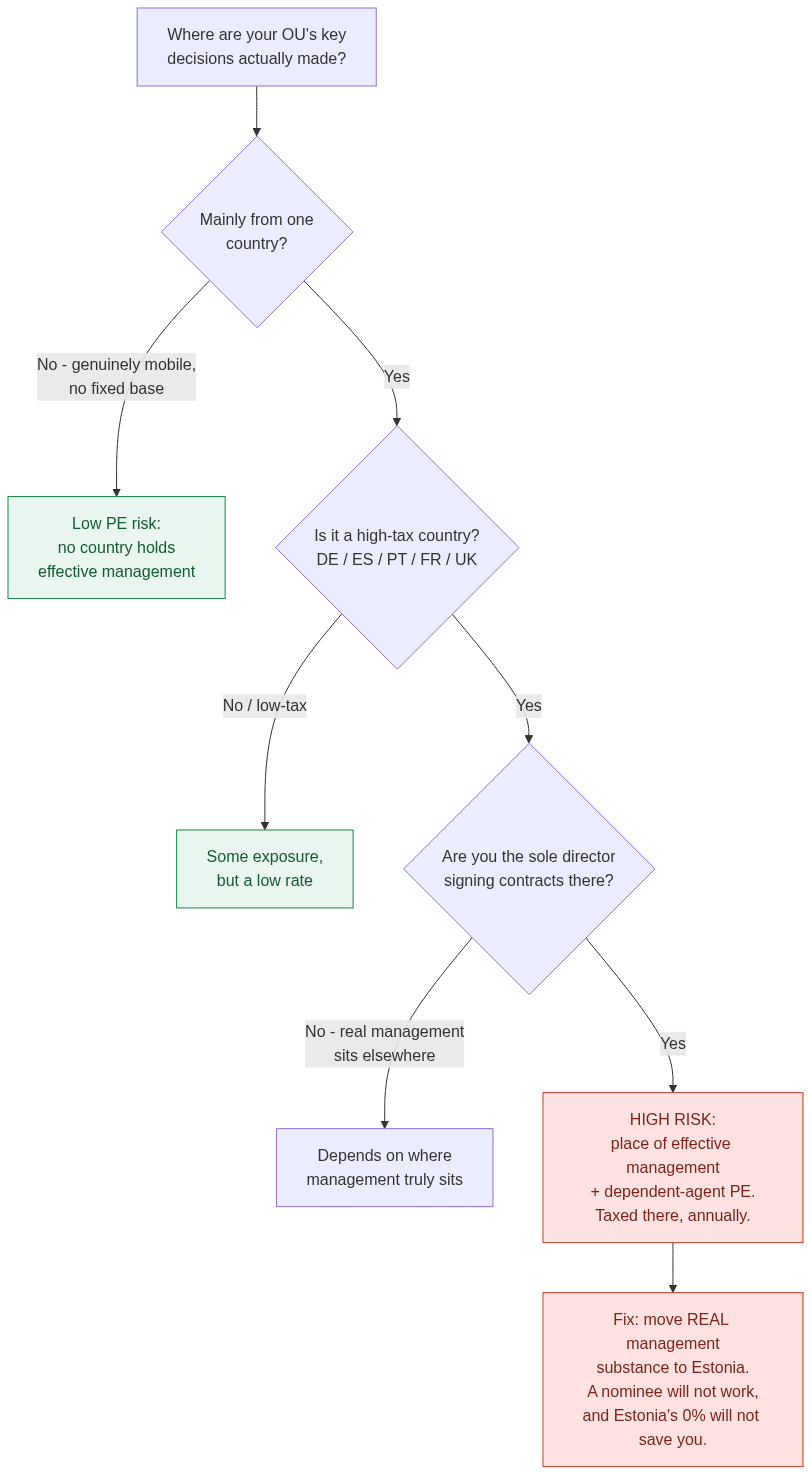
Run these in order. The first "yes" that creates a fixed, repeated, decision-making presence in a high-tax country is where your real risk lives.
- Do you make the company's key decisions mainly from one country? That country can claim effective management.
- Are you the sole director, signing contracts from that same country? That adds a dependent-agent PE on top.
- Do you work for the company from a home office there more than about half your time, on an ongoing basis? That strengthens the place-of-business case.
- Is that country a high-tax one (Germany, Spain, Portugal, France, the UK)? Then the exposure is large, not theoretical.
- Are you genuinely mobile with no country meeting the above, or is your real management in Estonia? Then the structure can work as intended.
When an Estonian OÜ still works
It works in two honest cases. First, the genuinely mobile founder with no single country of management and no permanent home that pulls residency, for whom no other country can assert effective management. Second, the founder who builds real substance in Estonia, where management decisions are actually taken in Estonia and the company has genuine Estonian economic activity.
That second case got stricter in 2025: Estonia itself now wants to see economic connection to Estonia before issuing an EU VAT number, so a substance-less shell is harder to run even from Estonia's side. The structure does not work as a tax play for a solo founder living full-time in a high-tax country. There it creates a permanent establishment, doubles your compliance, and hands the profit to your home tax authority, which is the opposite of what the 0% headline promised. If you are in that situation, read is an Estonian OÜ actually right for you before forming one.
How to reduce permanent establishment risk (and what does not work)
The only real cure is moving genuine management substance, not paper. If decisions are truly made in Estonia, or split across people and places so no one country holds effective management, the risk drops. Everything that looks like a shortcut tends to fail the substance-over-form test that every tax authority applies.
-
Real Estonian substance works but is demanding: actual decision-making in Estonia, genuine local activity. It is not a mailbox.
-
A nominee Estonian director who rubber-stamps your decisions does not work. Authorities look at who really decides, not who signs.
-
Splitting genuine functions across locations helps only if the split is real, not a story.
-
Treaties relieve double taxation but do not remove compliance. You may still have to register, file and pay in your home country, and the treaty can hand primary taxing rights to the high-tax country anyway.
The practical takeaway: choose the Estonian OÜ for what it is genuinely good at, clean online administration, distribution-based tax, and EU presence, and choose where you live with full knowledge that your residence, not your registration, sets the tax rate.
This is general educational information, not personal tax advice. Permanent establishment outcomes turn on your exact facts and the specific tax treaty between Estonia and your country. Confirm your position with a qualified adviser in your country of residence before acting.
FAQ
Does registering an Estonian OÜ make me an Estonian tax resident? No. The company becomes Estonian tax resident by registration, but you personally remain tax resident wherever your home and life are. e-Residency changes neither.
Can two countries tax the same Estonian company? Yes. Estonia taxes it as a resident, and a second country can tax it through a permanent establishment or by claiming effective management. A tax treaty then allocates and relieves, but both claims can exist at once.
I spend less than 183 days in any country. Is my OÜ safe? Not automatically. The 183-day rule is about your personal residency. Your company can create a permanent establishment in far less time, because its test is where management actually happens.
Does Estonia's 0% corporate tax mean I pay nothing if I have a PE abroad? No. The country where the PE sits taxes the profit under its own rules, usually annually. Estonia's 0% only defers the Estonian layer, which double-tax relief then reduces toward zero anyway.
What is the single biggest mistake founders make here? Treating e-Residency and the Estonian 0% rate as a personal tax outcome. They are a company-administration and corporate-deferral feature. Where you live still sets your real tax bill.
When is an Estonian OÜ genuinely tax-efficient? When you are truly mobile with no country of effective management, or when your management substance really is in Estonia. For a solo founder settled in a high-tax country, it usually is not.
If you want a sober answer for your own setup before you spend money forming a company, check whether an Estonian OÜ is right for you and what it actually costs all-in.