
TL;DR: A non-resident Estonian OÜ gets rejected for a business account because it cannot show a "strong connection to Estonia" - real staff, an office, Estonian customers or suppliers, or a single-shareholder company with easily traceable income. e-Residency itself is not enough; banks decide independently on ownership, management location, source of funds and substance. If you have no local substance and no in-person meeting option, stop applying to LHV or Coop and open an EU-regulated EMI (Wise, Payoneer, Narvi) instead. An Estonian IBAN is not legally required for an Estonian OÜ.
Why does a non-resident Estonian OÜ get rejected for a business account?
The single most common reason is a missing "connection to Estonia." Estonian banks approve companies that clearly serve, employ, or trade inside Estonia. A company with a foreign owner, no local staff, no Estonian customers and only a virtual-office address reads as a "technical" shell, and the bank declines. e-Residency does not change this.
Banks assess your OÜ on ownership structure, where it is actually managed, source of funds, transaction flows and economic substance - not on your e-resident status. The e-Residency knowledge base is explicit that e-Residency "does not guarantee" an account, and LHV states the e-resident digital ID "is not an identity document and e-resident status by itself is not a sufficient basis for opening a bank account." The bank account is a separate decision from company formation, made by the bank alone.
What does "strong connection to Estonia" actually mean?
It means the bank can see genuine economic activity tied to Estonia, or a clean, traceable single-owner business. The e-Residency guidance lists a strong connection as something "clearly explained in your company's plans" and "demonstrated based on your existing activities" - Estonian employees, relationships with local partners and suppliers, or serving the Estonian market.
There is one important carve-out that covers most digital nomads. The official guidance says a "location independent single shareholder with easily traceable income may also qualify." So you do not strictly need an Estonian office if you are a solo founder whose revenue is clean and easy to follow (one or two invoiced clients, predictable inflows). The problem cases are multi-owner structures, opaque cash flows, or anything routed through offshore entities.
Here is what each signal means in practice:
| What the bank wants | What counts in practice | What fails |
|---|---|---|
| Local substance | Estonian staff, a real office, Estonian customers or suppliers | Virtual-office address only, no local activity |
| Clean single-owner profile | One shareholder, invoiced income you can trace | Multiple UBOs with unclear roles |
| Transparent source of funds | Documented client contracts, 12-month account history | "Consulting" with no contracts or paper trail |
| Ownership you can explain | A short, flat ownership chart | Holding layers, offshore companies in the chain |
| A reason to bank in Estonia | Estonian market focus or EU operating base | Company that only exists on paper |
What are the top rejection reasons, and the fix for each?
Most rejections trace to five issues, and each has a concrete fix. The pattern is consistent: banks reject on substance, structure, and traceability, so the fix is always to add a real Estonian tie, simplify the structure, or paper the money trail - or to route around a traditional bank entirely.
| Rejection reason | Concrete fix |
|---|---|
| No connection to Estonia (most common) | Add a genuine tie: an Estonian client or supplier contract, a contractor based in Estonia, or a documented plan to serve the Estonian market. If none is real, do not manufacture one - go to an EMI. |
| Relying on e-Residency as proof | Treat e-Residency as formation only. Bring passports of board members and UBOs (over 25%), a notarised ownership overview, and articles of association translated to Estonian, Russian or English. |
| Offshore in the ownership chain | Remove offshore holding entities from the structure before applying. LHV declines companies "registered in an offshore location or whose ownership structure includes companies registered in offshore countries." |
| UBO in a sanctioned or FATF grey/black-list country | This is close to a hard stop at most banks and EMIs. Resolve the UBO issue first; no application wording gets around a sanctions or high-risk-jurisdiction flag. |
| Weak or unexplained source of funds | Provide a 12-month account statement and a registry statement from the last 6 months, plus client contracts. Non-residents face enhanced due diligence, so over-document rather than under-document. |
The documents LHV actually asks for
For a foreign-registered company or a non-resident without an Estonian ID, LHV requests a set that most rejected applicants simply never assembled: passport copies of board members and beneficial owners over 25%, a detailed ownership and beneficial-ownership overview, notarised articles of association translated to Estonian, Russian or English, a notarised list of signatories, a certified registry statement from the last 6 months, and an account statement for the last 12 months. Show up with all of it or expect delay and rejection.
Traditional bank or EMI - which one fits your profile?
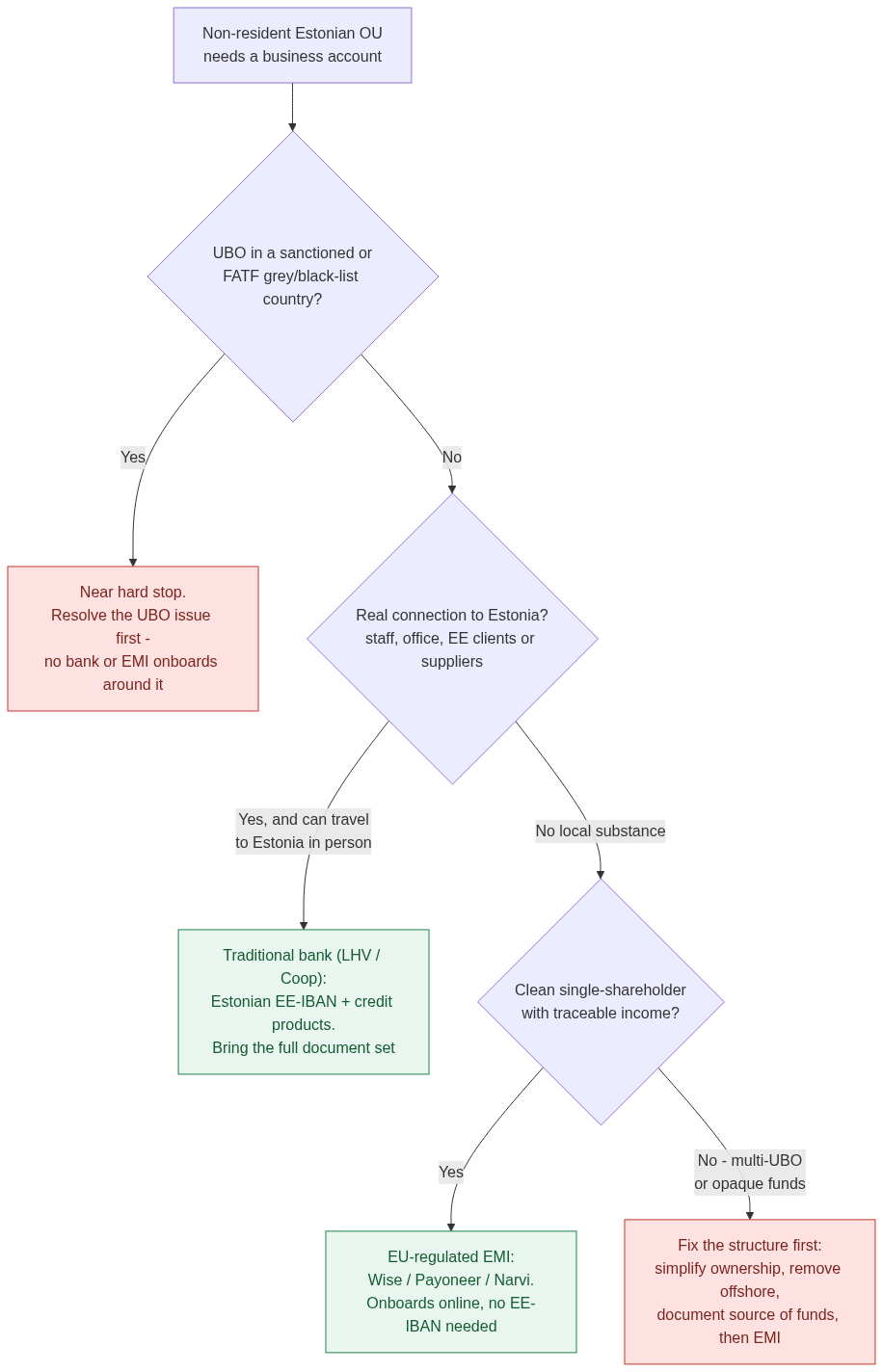
Match the account type to your substance. If you have real Estonian activity and can travel to Tallinn for an in-person meeting, a traditional bank (LHV, Coop) gives you an Estonian IBAN plus credit products. If you are a remote solo founder with no local staff and no plan to visit, an EU-regulated EMI is the realistic route and onboards you online.
The traditional-bank blockers for non-residents are structural, not just paperwork: banks usually require an in-person visit to open the account, and they apply enhanced due diligence to foreign owners. Payment institutions and fintechs onboard entirely online and are, in the e-Residency guidance's words, "a good option for early stage entrepreneurs" - at the cost of no business loans or credit lines. For a nomad-run OÜ invoicing a handful of clients, that tradeoff is almost always worth it.
When should you stop trying a traditional bank?
Stop after one clean, fully-documented rejection - do not keep re-applying with the same profile. If you have no Estonian substance, cannot attend an in-person meeting, or a UBO sits in a high-risk jurisdiction, a traditional Estonian bank is structurally not for you and repeat applications will not change the answer. Move to an EU EMI.
An Estonian OÜ is not legally required to hold an Estonian IBAN. As the guidance puts it, "it's not necessary to open a business account in the same country where your company is registered." Your OÜ can operate on an EEA account, which is exactly what Wise, Payoneer and Narvi provide. The one thing to confirm before you commit: check that your provider issues an IBAN your Estonian accountant and the tax office (EMTA) accept for reporting, and that it supports your currencies.
One gap worth naming: real bank and EMI onboarding screenshots (LHV's application flow, a Wise Business approval screen) would strengthen this and confirm the exact current document lists. Those cannot be captured here without live, account-specific access, so treat the document lists above as the sourced baseline and verify the latest wording on the provider's own onboarding page before applying.
FAQ
Does e-Residency give me an Estonian bank account? No. e-Residency lets you form and manage an OÜ online, but the bank account is a separate decision made independently by each bank or EMI based on substance, ownership and source of funds. The official guidance states e-Residency does not guarantee an account.
Can a non-resident open an LHV business account with no Estonian connection? Very unlikely. LHV requires a clear connection to Estonia and declines companies that look like technical shells or that have offshore entities in the ownership chain. Without local substance or a traceable single-owner profile, expect rejection.
Do I legally need an Estonian IBAN for my OÜ? No. An Estonian OÜ can hold its account at any suitable EEA institution. It is not necessary to bank in the same country where the company is registered, so an EU EMI account is fully valid for operating the company.
Is a Wise or Payoneer account a "real" bank account for my OÜ? They are regulated EMIs, not banks, so they provide IBANs and payment services but no business loans or credit lines. For a remote solo founder that is usually enough. Confirm the IBAN is accepted for your Estonian accounting and tax reporting.
What is the single fastest fix if I keep getting rejected? Stop applying to traditional banks and open an EU-regulated EMI online. If a UBO is in a sanctioned or FATF grey/black-list country, resolve that first - no provider onboards around it.
Why does the bank keep asking for source-of-funds documents? Non-residents get enhanced due diligence. Banks want a 12-month account statement, a recent registry statement and client contracts to trace your income. Under-documenting is a top rejection cause; bring more than you think you need.
This is general information, not personal financial or tax advice. Bank and EMI onboarding criteria change and are applied case by case - confirm current requirements with the provider and your Estonian accountant before you apply.
If you want the structure sorted before you ever hit an application form - a clean single-owner setup, the right substance signals, and the account type that matches your profile - that is exactly the groundwork Nomad Entity helps founders get right.
Related reading: Estonian OÜ banking in 2026, the Estonian permanent-establishment trap, is an Estonian OÜ right for you, and what e-Residency actually gets you.